

Which Enlightenment Philosopher First Popularized
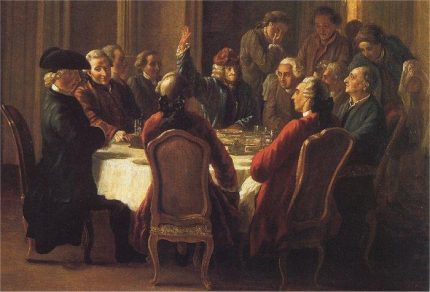
The philosophes (French for 'philosophers') were writers, intellectuals and scientists who shaped the French Enlightenment during the 18th century. The best known philosophes were Baron de Montesquieu, Voltaire, Jean-Jacques Rousseau and Denis Diderot. Other bottom-known figures included the mathematician and political scientist Nicolas de Condorcet, religious critic Nicolas Boulanger and atheist writer Jacques-Andre Naigeon.
Impact on the revolution
The impact these philosophes, their writings and theories had on the French Revolution has sometimes been exaggerated and is open to debate.
None of the philosophes were revolutionaries and very few advocated or even predicted a revolution. Indeed, virtually were intellectual elitists with little regard for the mutual people, believing they had picayune or no function in authorities. Most of the significant philosophes were also dead long before 1789.
Despite this, their writings and ideas, specially their political theories and criticisms of the Ancien Régime, helped create an environment where revolutionary ideas could germinate and prosper.
Montesquieu
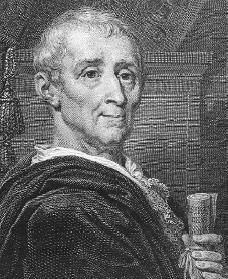
Charles de Secondat, Baron de Montesquieu (1689-1755) was an enlightened nobleman turned political philosopher, responsible for articulating a clear caption of the separation of regime powers.
Montesquieu was born into a noble family unit near Bordeaux in January 1689. Several of his relatives were involved in provincial politics, so the teenage Montesquieu as well adult an interest in law and government. The family'south wealth gave him the opportunity to read, write and socialise.
The young Montesquieu became a song and charismatic regular in the Paris social set, where he spoke freely and critically about the Ancien Régime. He also travelled widely in Europe, observing and studying unlike forms of police and government.
Past his late 20s, Montesquieu had worked as a lawyer, an academic and a history lecturer. He also began writing in earnest. His first significant public work was Farsi Letters (1721), which satirised many aspects of French order.
His early writings reveal Montesquieu equally a liberal, a deist and a supporter of constitutional monarchy. He was less receptive to republicanism or democracy.
Like other intellectual giants of his age, Montesquieu believed that government was best left to educated and aware elites. Common people, Montesquieu argued, were also shiftless and poorly equipped to discuss either law or the business of government. Montesquieu also believed that political systems must be organised so that those in authorities could non accumulate or corruption power.
The Spirit of the Laws
Montesquieu expanded on this point in his all-time-known work, De fifty'Esprit des Lois ('The Spirit of the Laws'), which was published anonymously in 1748. The Spirit of the Laws compared dissimilar systems of government, with a particular focus on how each system protected individual liberty.
Expanding on ideas previously explored past the English philosopher John Locke, Montesquieu decided the all-time means of protecting individual liberty was through the separation of government powers. The different functions of regime – executive or monarchical, legislative and judicial – must be carried out by different people and dissimilar departments. The power of each branch of government must be limited, ideally by a constitution.
The Spirit of the Laws was despised by the church building and placed on its list of prohibited books, notwithstanding, it proved very popular and sold thousands of copies across Europe. Montesquieu died seven years after the outset edition, however The Spirit of the Laws became arguably the most significant work of Enlightenment political theory, shaping the outcomes of the American and French revolutions.
Voltaire

'Voltaire' was the pen proper name of the French author Francois-Marie Arouet (1694-1778). He was born in Paris to a moderately wealthy family, the son of a regime official. Arouet received a Jesuit education in Greek, Latin and the law. A free-spirited character in his youth, at age 20 Arouet attempted to elope with a young French émigré but the plot was discovered past his male parent.
After arriving dorsum in Paris, Arouet spent a year imprisoned in the Guardhouse for writing libellous poems about members of the aristocracy. Around this time he adopted the pen name Voltaire, a Latinised anagram of his real name.
While detained in the Bastille Voltaire penned Oedipus, a tragic play that hints at sexual debauchery and incest among members of the French aristocracy. Oedipus was a literary and dramatic success, subsequently performed to packed houses in Paris, while Voltaire adopted writing as his profession.
Letters on the English language nation
In 1726, a lettre de cachet was issued against Voltaire. Rather than face another long stint in the Bastille Voltaire went into voluntary exile in England, where he remained for iii years.
During his stay, Voltaire became fascinated past English social club, authorities and law. He came to admire English literature, specially Shakespeare; its constitutional monarchy; its freedom of speech and the printing, particularly the open criticism and mockery of political figures in London newspapers and pamphlets.
Voltaire returned to France in 1729 and published Letters on the English Nation. It caused considerable controversy in France, comparing the English organisation with the French arrangement and finding the latter wanting. Voltaire was particularly astringent on organised faith, which did non dominate or define English language guild as information technology did in France.
Voltaire continued to write prolifically and in a range of formats, producing novels, novellas, essays, plays, satires and open letters. He could write in many voices, with profound seriousness, great subtlety or clever wit – or he could pour contemptuousness and vitriol on his targets. Politically, Voltaire was no democrat. He had no faith in the ordinary people, who he considered apathetic and as well concerned with trivialities.
Religious criticisms
Voltaire was also an advocate of religious tolerance. Throughout his life he was a fierce critic of the Catholic church, condemning its endemic corruption and the greed and depravity of high ranking clergymen.
He wrote sourly about the church building'southward vast landholdings and the big tithes information technology imposed on the struggling peasantry. He condemned venality in the church, criticising the practice of nobles ownership positions in the clergy, and complained nigh the Vatican intervening in French civil matters.
Supporters of the church building damned Voltaire as a heretical atheist but like many other philosophes, in reality, he was a deist who believed in God but distrusted organised organized religion.
A historian's view:
"Voltaire was essentially a crusader like [Martin] Luther, always stronger in destruction than in positive structure. He was, says 1 historian, "the Spirit of the Enlightenment incarnate, with all its virtues and all its faults. Everything he said and wrote was as stimulating as the java on which he lived"."
Frederick Artz
Rousseau
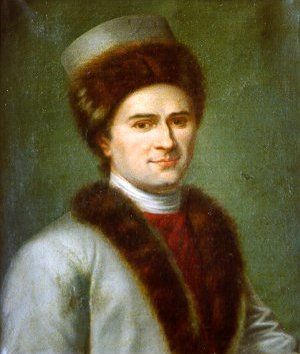
Jean-Jacques Rousseau (1712-1778) was another Enlightenment writer whose political and philosophical ideas shaped the French Revolution. Rousseau was built-in in Switzerland to a successful middle-class family. His female parent died a few days after Rousseau's birth; his father was a 3rd-generation watchmaker.
The young Rousseau was raised around craftsmen and artisans. He became an avid reader, though he had petty in the mode of formal education. Rousseau spent most of his 20s travelling, working a diverseness of menial jobs while studying and educating himself. In his 30th year, he moved to Paris, where he later befriended young man philosophe Denis Diderot and had an commodity published in Diderot'due south famous Enlightenment work Encyclopédie.
Much of Rousseau's writing was undertaken in the final two decades years of his life. He wrote on a broad range of topics and addressed many social, political and philosophical issues. His Discourse on Inequality (1755) offers Rousseau's ideas virtually why individuals live in and tolerate profoundly unequal conditions, particularly in civilised societies. I of Rousseau's about famous works was Emile (1762), a novel that explores the nature of teaching and the corrupting influences of club on young individuals.
Probably Rousseau's nigh meaning contribution to Enlightenment political theory was his 1762 workThe Social Contract. In this book, he made a elementary but now famous statement: "Homo is born free, nonetheless everywhere he is in fetters [chains]".
Rousseau pondered why people voluntarily submitted to the rule of kings and governments, surrendering their freedoms and liberties in the process. The respond, he concluded, was that humans are essentially expert and want peace, stability and good order. Civilised human order cannot exist without government and laws to keep order.
During this exploration, Rousseau articulated the idea of the 'social contract', an unwritten understanding that exists between governments and individuals. He also articulated the concept of pop sovereignty, suggesting that the true ability of government was derived from the consent of the people.
Popular sovereignty became a critical idea that justified the American and French revolutions. These revolutionaries embraced Rousseau's belief that political systems, while never perfect, must strive to progress and improve.
One of Rousseau's more contentious claims was that individual holding was an impediment to good political leadership. Property interests, Rousseau suggested, distracted politicians from their principal roles: representing the people and ensuring morality. Rousseau also advocated the concept of civic religion, a religion to worship God and uphold morality rather than served vested interests.
"That oversupply of obscure writers and idle men of messages who devour the substance of the state to no do good any… they smile disdainfully at those quondam words 'patrie' and 'organized religion' and devote their talents and their philosophy to destroying and debasing all that is sacred among men. Not that they hate either virtue or dogmas; they are enemies of public opinion, and banishing them amidst atheists would be enough to bring them back to the pes of the altars."
Rousseau on political pamphleteers
Diderot

Denis Diderot (1713-1784) was another prominent figure of the French Enlightenment. The son of a cutlery maker, Diderot was built-in in Champagne, northern France. He received a Jesuit educational activity and moved to Paris with the intention of joining the clergy, before choosing to study constabulary instead.
Soon subsequently, Diderot turned to writing. He spent his early years undertaking modest writing and translation jobs and filling clerical positions. His lack of connections prevented Diderot from obtaining any significant writing roles and, every bit a consequence, he was frequently broke.
Amidst his early on writings were a history of Greece, an anthology of short stories and essays containing criticisms of the Catholic church. One of Diderot's essays was condemned equally heretical and in 1749 he was arrested and imprisoned for several months.
Encyclopédie
Diderot's most famous literary contribution was Encyclopédie. Commenced in 1750 just not completed until 1772, Encyclopédie was an aggressive project that aimed to gather and organise all of the earth'south essential cognition.
Information technology independent hundreds of articles and essays across a myriad of subjects, including the physical and natural sciences, mathematics, astronomy, religion, theology, history, politics, club, literature, music and the visual arts. Different other books of its kind Encyclopédie also contained entries on artisanship and piece of work, covering fields like farming, architecture, applied science, carpentry, masonry and manufacturing.
The articles in Encyclopédie were written by dozens of well qualified experts and philosophes, most of whom were politically progressive.
While Encyclopédie was non itself a political text, some of its entries independent implied criticisms of traditional behavior. Moreover, making knowledge bachelor to anybody helped to undermine the dominance and dominance of both France's absolutist monarchy and the Catholic church. Encyclopédie was published openly in France until 1759 when it was outlawed, mainly at the behest of the church.
"It has been said that we are all born equal, but this is not so… Amongst men, there is an original inequality that zip can resolve. It must last forever. All that ane can obtain from the all-time legislation is not to destroy this inequality, but to prevent abuses arising out of information technology."
Denis Diderot

1. The philosophes were writers and intellectuals of the French Enlightenment. The writings of the philosophes contributed to revolutionary ideas and criticisms of the Ancien Régime.
2. Baron de Montesquieu was a political theorist whose 1732 book The Spirit of the Laws articulated and popularised the idea of the separation of government powers as a means of preventing tyranny.
3. Francois-Marie Arouet, or Voltaire, was a prolific writer on a range of subjects. Voltaire was particularly known for his criticisms of organised religion and his condemnations of its venality and corruption.
4. Jean-Jacques Rousseau was a Swiss philosopher whose writings focused on education, government and natural rights. Rousseau is best known for developing the theory of a 'social contract' between individuals and their authorities.
5. Denis Diderot was a French writer who compiled the Encyclopédie, an Enlightenment text that assembled all existing human knowledge and made it available to all, undermining the potency of the monarchy and the Catholic church.
Citation data
Title: "The philosophes"
Authors: Jennifer Llewellyn, Steve Thompson
Publisher: Alpha History
URL: https://alphahistory.com/frenchrevolution/philosophes/
Date published: Oct twenty, 2019
Appointment accessed: October 06, 2022
Copyright: The content on this page may not be republished without our express permission. For more information on usage, delight refer to our Terms of Utilise.

Which Enlightenment Philosopher First Popularized,
Source: https://alphahistory.com/frenchrevolution/philosophes/
Posted by: westficip1940.blogspot.com
0 Response to "Which Enlightenment Philosopher First Popularized"
Post a Comment